How KRUK and Elitmind Built an AI-Ready Data Platform to Support Faster Debt Collection

Audio Highlights
This component uses custom JavaScript to open and close. Custom attributes and additional custom JavaScript is added to this component to make it accessible.
Video Highlights
This component uses custom JavaScript to open and close. Custom attributes and additional custom JavaScript is added to this component to make it accessible.
A modular enterprise platform connecting DWH, BI, Data Science and Data Governance across seven European markets, while combining Group-wide standards with local analytical autonomy.

Why is Data & AI important to KRUK’s debt collection strategy?
Shortening debt collection cycles depends on many parts of KRUK’s business, from processes and organization to technology and decision-making. Data and AI are one part of that transformation. Analytics and machine learning can support decisions across portfolio management, segmentation, collection prioritization, forecasting and strategy testing. To develop these capabilities at Group scale, KRUK needed a common foundation that could support teams working across different analytical disciplines and countries.
The opportunity was to bring Data Warehouse, Business Intelligence and Data Science closer together, supported by common Data Governance, so teams could build on each other’s work and make useful capabilities easier to reuse. The platform also needed to connect centrally developed capabilities with the business knowledge and analytical needs of individual countries.
What KRUK and Elitmind Built
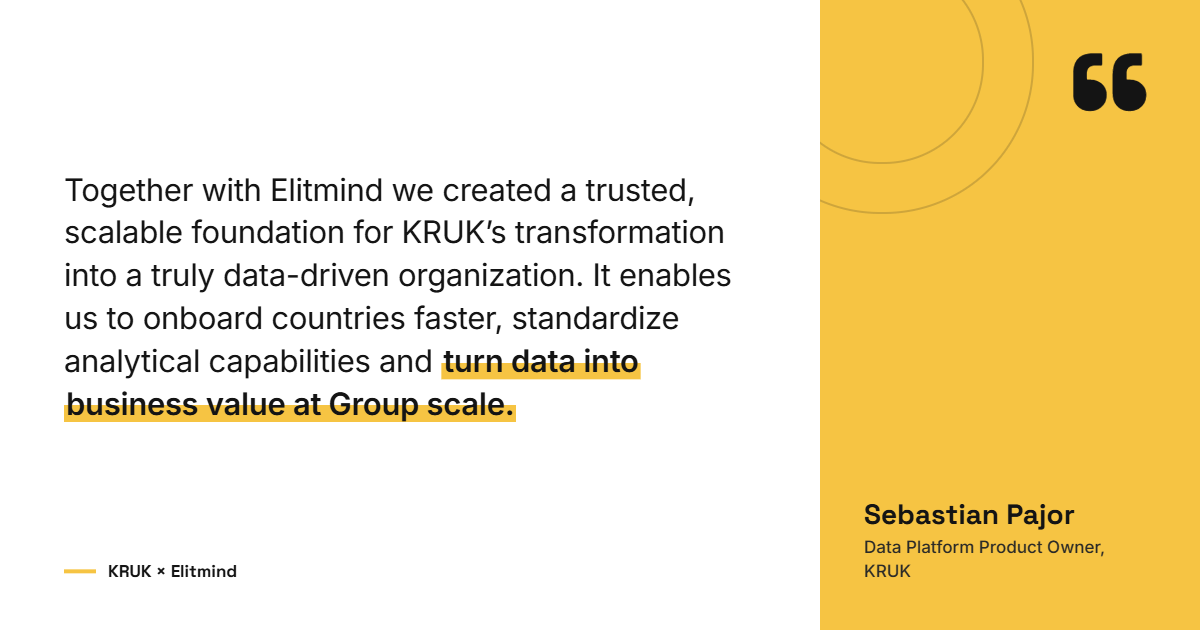
KRUK and Elitmind implemented a central, modular Data & AI Platform covering the analytical journey from data processing and warehousing through Business Intelligence to Data Science and machine learning.
The platform gives DWH, BI and Data Science teams a shared environment where data products, analytical components and ML features can be developed and reused, with Data Governance embedded into the way the platform operates. For KRUK, this creates one foundation across two dimensions of the organization: analytical disciplines and geographic markets.
Azure Databricks supports data engineering, Data Warehouse workloads, Data Science, machine learning and feature engineering. Microsoft Fabric and Power BI provide semantic modelling, reporting and self-service analytics. Microsoft Purview supports data cataloguing, lineage, ownership and governance. Together, these technologies provide the foundation KRUK teams need to develop analytical and AI capabilities and make them available across the organization.
How does one platform connect DWH, BI, Data Science and Data Governance?
Bringing these capabilities onto one platform makes it easier for analytical teams to build on each other’s work. Data prepared and governed within the platform can support both Business Intelligence and Data Science. Analytical components and ML features created for one use case can become building blocks for another. Capabilities developed centrally can be made available to countries without requiring each market to create its own platform foundation.
For KRUK, this creates a more direct path from data to analysis, from analysis to models and from models to their use in business processes. It also provides a foundation for moving useful analytical and AI ideas beyond individual projects and making them reusable across teams and markets.
How does KRUK combine Group standards with local analytical autonomy?
KRUK operates across markets with different portfolios, customer behaviours and local business needs. Its Data & AI Platform therefore follows a hub-and-spoke architecture.

The central hub provides shared platform capabilities, governance, technology standards and reusable components. Local countries operate as spokes, giving their analytical teams the autonomy to develop reporting, insights and analytical use cases for their markets while working within Group-wide standards.
This model gives KRUK a common Data & AI foundation while preserving the flexibility local teams need to respond to their own business requirements.
The approach is already working in production. Three countries have been onboarded to the central platform using the common model. The first data domains and machine learning models have also been deployed to production using repeatable delivery patterns. Each additional country, data domain or analytical use case can build on an established platform, reusable components and a delivery approach that has already been used in production.
What makes the platform AI-ready?
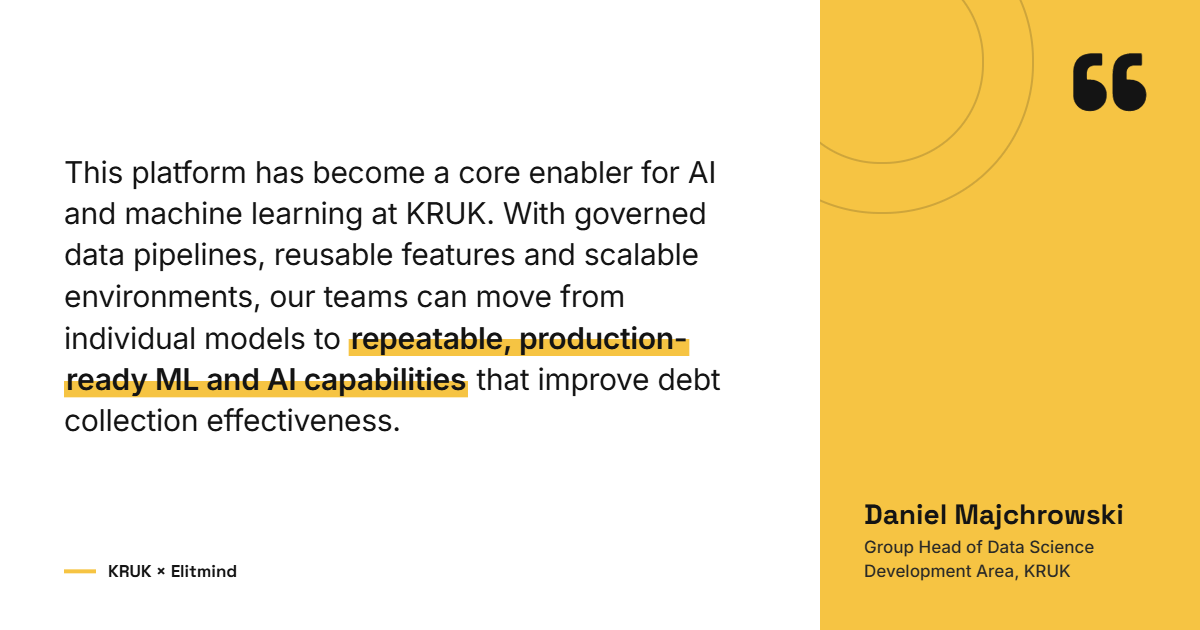
For KRUK, being AI-ready means having the foundations required to move from individual analytical models to AI capabilities that can be developed, deployed and reused across the organization. That requires governed data pipelines, reusable features, scalable Data Science environments, consistent development patterns and a clear route into production.
The platform provides those building blocks. This creates a common foundation for use cases such as segmentation, collection prioritization, forecasting, propensity modelling, strategy testing, intelligent recommendations and performance monitoring. As these capabilities mature, KRUK can reuse the same platform, data foundations and delivery patterns across teams and countries.
How does the platform support faster debt collection?
KRUK’s strategic objective is to shorten debt collection cycles. The Data & AI Platform supports that broader strategy by giving teams a common foundation for developing analytical and AI capabilities that can improve decisions throughout the collection process.
Those capabilities can help KRUK better understand portfolios, improve segmentation, prioritize collection activities, forecast outcomes and test collection strategies. The platform also makes it possible to take successful approaches further. A data domain, analytical component or ML capability developed for one use case can become part of a foundation that other teams and countries can build on.
This is where the platform contributes to KRUK’s wider transformation: by making Data & AI capabilities easier to develop, operationalize and scale across the Group
What has KRUK already put into production?


What does this foundation make possible next?
KRUK now has a common foundation on which DWH, BI and Data Science teams can continue developing analytical capabilities together, supported by Group-wide Data Governance.
It also has a working model for bringing those capabilities into individual countries while maintaining local analytical autonomy. The first country onboardings, production data domains and ML deployments show that the model can be repeated.
As KRUK expands the platform across additional countries, domains and AI use cases, teams can build on the same foundation instead of creating a new one each time. That gives KRUK an enterprise-scale Data & AI capability designed to evolve alongside its broader transformation and support its strategic objective of shortening debt collection cycles.

Meet the authors