What's New in Microsoft Fabric: FabCon & SQLCon 2026
.png)
Audio Highlights
This component uses custom JavaScript to open and close. Custom attributes and additional custom JavaScript is added to this component to make it accessible.
Video Highlights
This component uses custom JavaScript to open and close. Custom attributes and additional custom JavaScript is added to this component to make it accessible.
If you've been watching Fabric evolve from the sidelines, now is the moment to pay attention.
At FabCon & SQLCon 2026, Microsoft did not simply announce features - it presented a strategic blueprint for a converged data platform where databases, analytics, governance, and AI-driven planning operate as one. For teams still running fragmented toolchains, several of these announcements signal a turning point.
The data platform just got a whole lot smarter. One announcement alone could eliminate entire categories of tools your team relies on today. Margerita Sołtysiak and Adrian Kukiełka break down what shipped, what it means, and whether your architecture is ready for what comes next.
The answers are below, and some of them might surprise you.
1. Fabric IQ Planning
Status: Preview
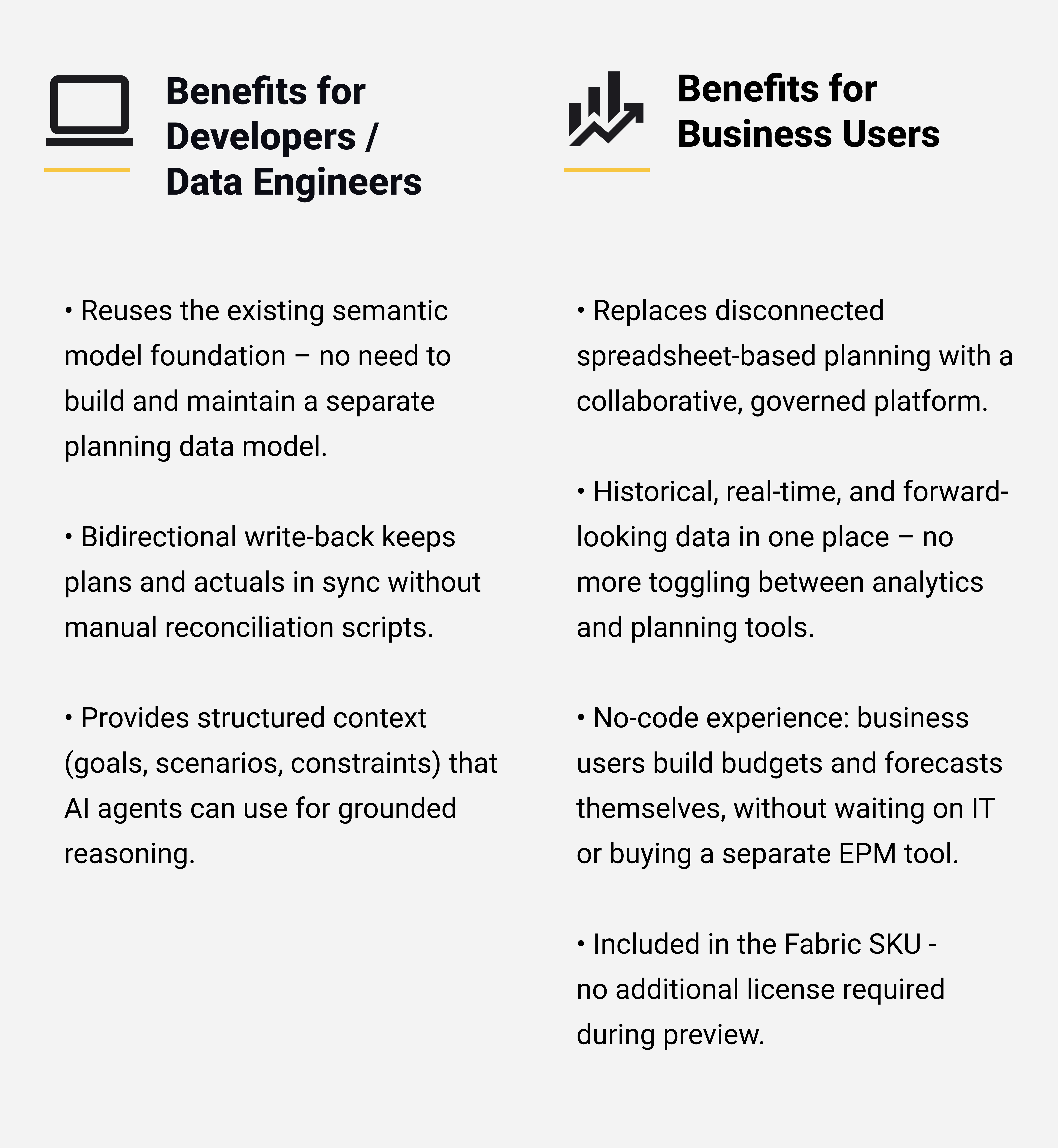
For years, planning has lived outside the data platform. Budgets sit in spreadsheets, forecasts in a standalone EPM tool, and targets in yet another system. By the time all of that is reconciled, the numbers are already stale. Planning in Fabric IQ tackles that gap head-on by bringing budgets, forecasts, scenarios, and targets directly into Fabric’s governed semantic layer.
Because it is built on Power BI’s semantic model technology, Planning reuses your existing KPIs and dimensions. It offers no-code planning sheets for business users, PowerTable sheets for master and reference data, and Intelligence sheets for analytical exploration. Write-back is bidirectional: revised targets are reflected immediately. And because planning data sits alongside historical actuals and real-time signals, you can answer “what happened, what’s happening, and what should happen” from one place.
For organizations investing in AI agents, this is especially relevant. Planning provides the intent layer – goals, constraints, trade-offs – that agents need to reason about the business rather than just crunch data. Meters have been created for the feature but are not billed during the preview period.
Sources:
Planning in Fabric IQ Blog, Fabric IQ docs , Plan (preview) docs , Azure Blog
2. OneLake Security
Status: GA (coming weeks)
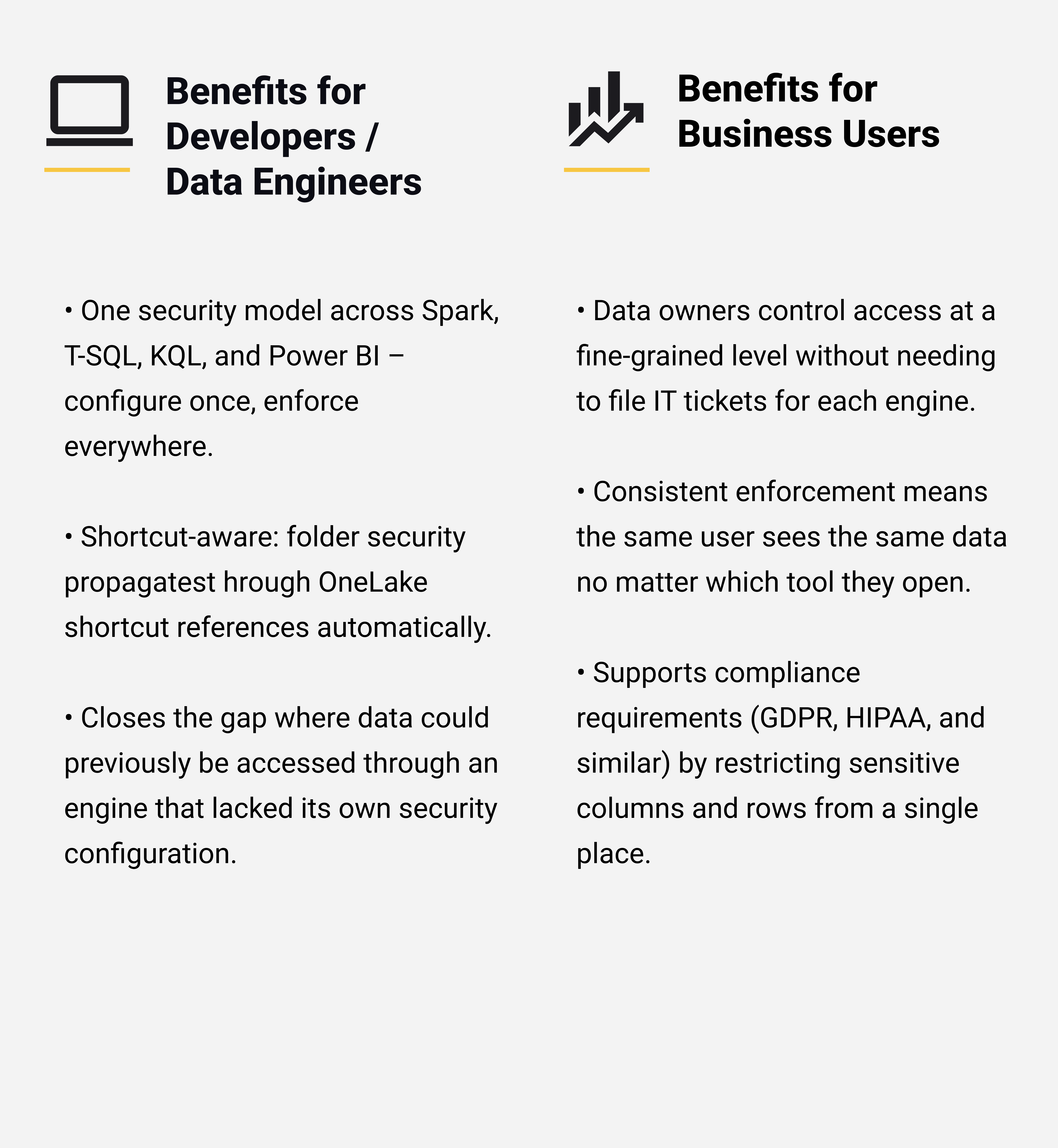
Until now, securing data in Fabric often meant configuring access rules separately for each compute engine – one set in the SQL endpoint, another in Spark, yet another in Power BI. OneLake security replaces that fragmented approach with a single, data-plane security model that follows the data regardless of how it is queried.
Data owners can define role-based access at the table/folder leve and layer on column-level (CLS) and row-level (RLS) restrictions. Roles are created by workspace Admins or Members and apply to users with Viewer access or Read permission. A DefaultReader role ships with every lakehouse and can be customized or removed. Security also propagates through shortcuts, so linked data stays protected.
Sources: OneLake Security docs , Azure Blog
3. OneLake Enhancements (Shortcuts & Mirroring)
Status: Various (GA / Preview)
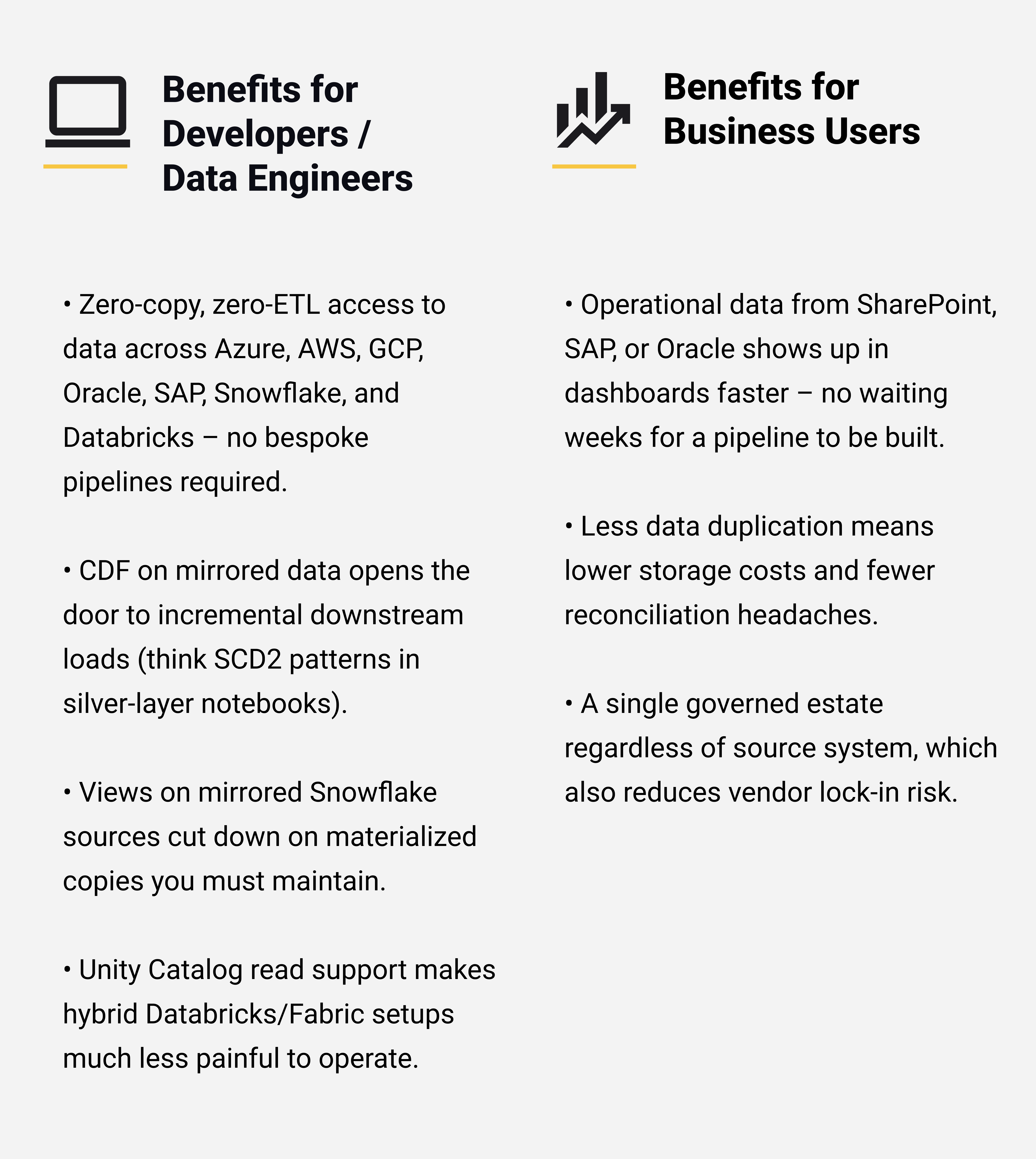
OneLake is Fabric’s unified data lake – think of it as the OneDrive for your entire analytics estate. The core idea is simple: connect data where it already lives, without copying it. At FabCon 2026, Microsoft widened the net considerably. Mirroring now covers SharePoint lists and Dremio (both in preview), with Azure Monitor on the way, while Oracle and SAP Datasphere mirroring reached general availability. On top of the basic mirroring, there are new extended capabilities: Change Data Feed (CDF) and the option to create views over mirrored data, starting with Snowflake. These extended features will be a paid add-on.
Separately, Databricks users can now read OneLake data natively through Unity Catalog (public preview), and Snowflake interoperability is GA. In short, the list of systems that can talk to OneLake without custom plumbing keeps growing.
Sources: OneLake Blog, Azure Blog
4. Shortcut Transformations
Status: Generally Available
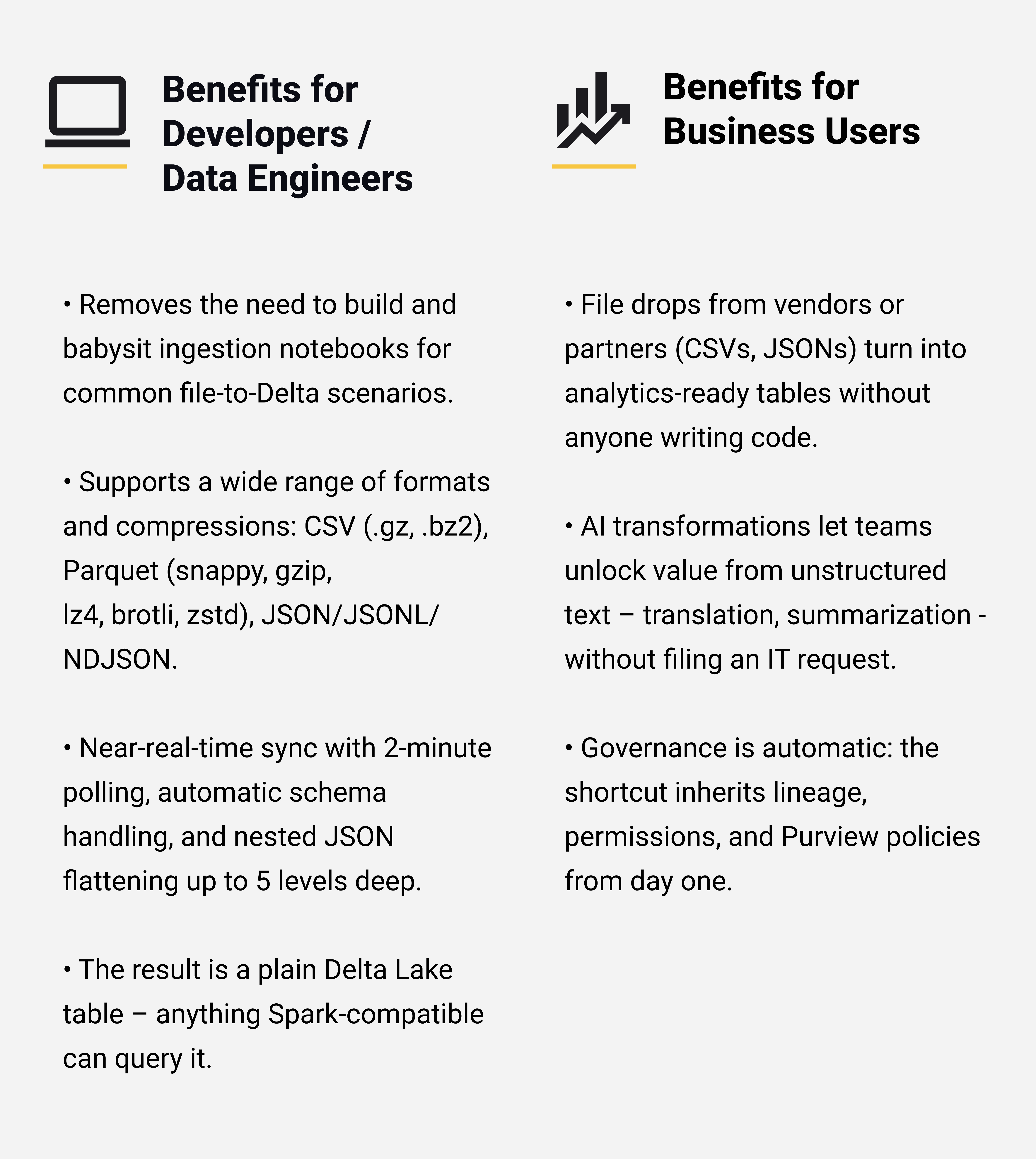
If you’ve ever written yet another notebook whose only job is to read CSVs from a landing zone and write them as Delta – this feature is for you. Shortcut transformations take raw files (CSV, Parquet, JSON) referenced by a OneLake shortcut and convert them into Delta Lake tables automatically. Fabric’s Spark compute handles the heavy lifting: it polls the shortcut target every two minutes, picks up new or changed files, and updates the Delta table accordingly. Deleted source files are reflected too.
On top of format conversion, you can apply AI-powered transformations like summarization, translation, and document classification. Excel-to-Delta support is now in preview as well. The output inherits OneLake lineage, permissions, and Purview policies – governance comes built in.
Sources: Shortcut Transformations docs, OneLake Blog, Azure Blog
5. Fabric MCP (Local & Remote)
Status: Local: GA | Remote: Preview
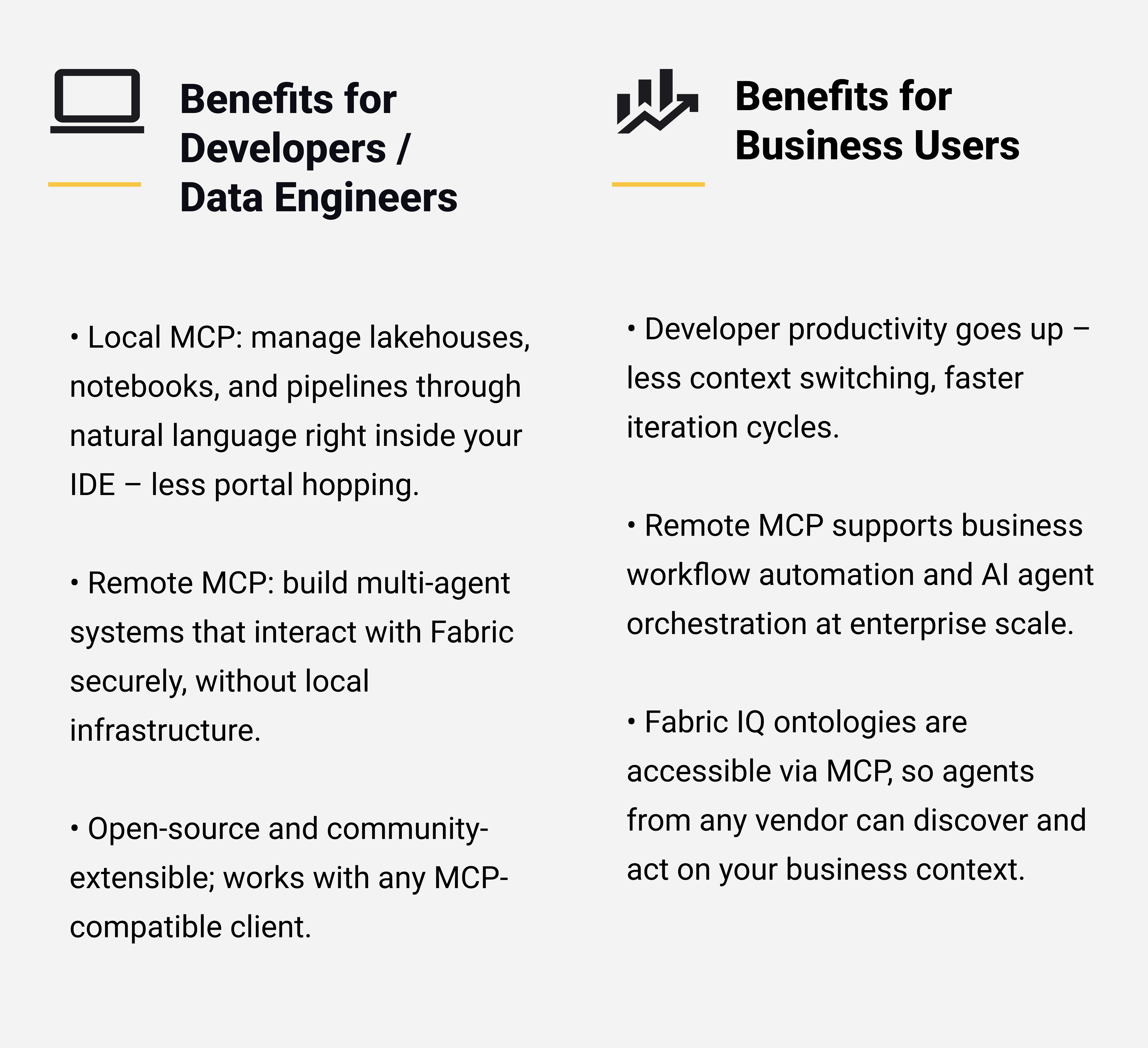
Fabric local MCP is an open-source server that runs on your machine and connects AI coding assistants – primarily GitHub Copilot – straight to Fabric. Instead of switching to the portal to check a lakehouse or trigger a pipeline, you describe what you need in natural language from your terminal, and the assistant handles it. Local MCP is now generally available.
Fabric remote MCP (public preview) takes the same idea to the cloud. It is a secure, hosted execution engine that lets AI agents and automation tools perform authenticated Fabric actions without requiring anything installed locally. This is the piece that matters for multi-agent architectures and operational automation at scale.
Sources: Azure Blog
Not sure where Fabric fits in your stack?
Most data teams are still paying for tools Fabric just replaced.
Check if yours are on that list: book a free consultation with our team.
Meet the authors

.jpg)



.png)









.png)
.png)









.png)