Data Governance Maturity Assessment Guide: Frameworks, Best Practices & How to Get Started
.jpg)
Audio Highlights
This component uses custom JavaScript to open and close. Custom attributes and additional custom JavaScript is added to this component to make it accessible.
Video Highlights
This component uses custom JavaScript to open and close. Custom attributes and additional custom JavaScript is added to this component to make it accessible.
A maturity assessment is a structured, evidence-driven way to evaluate how well your organization governs its data - and what it would take to do it better.
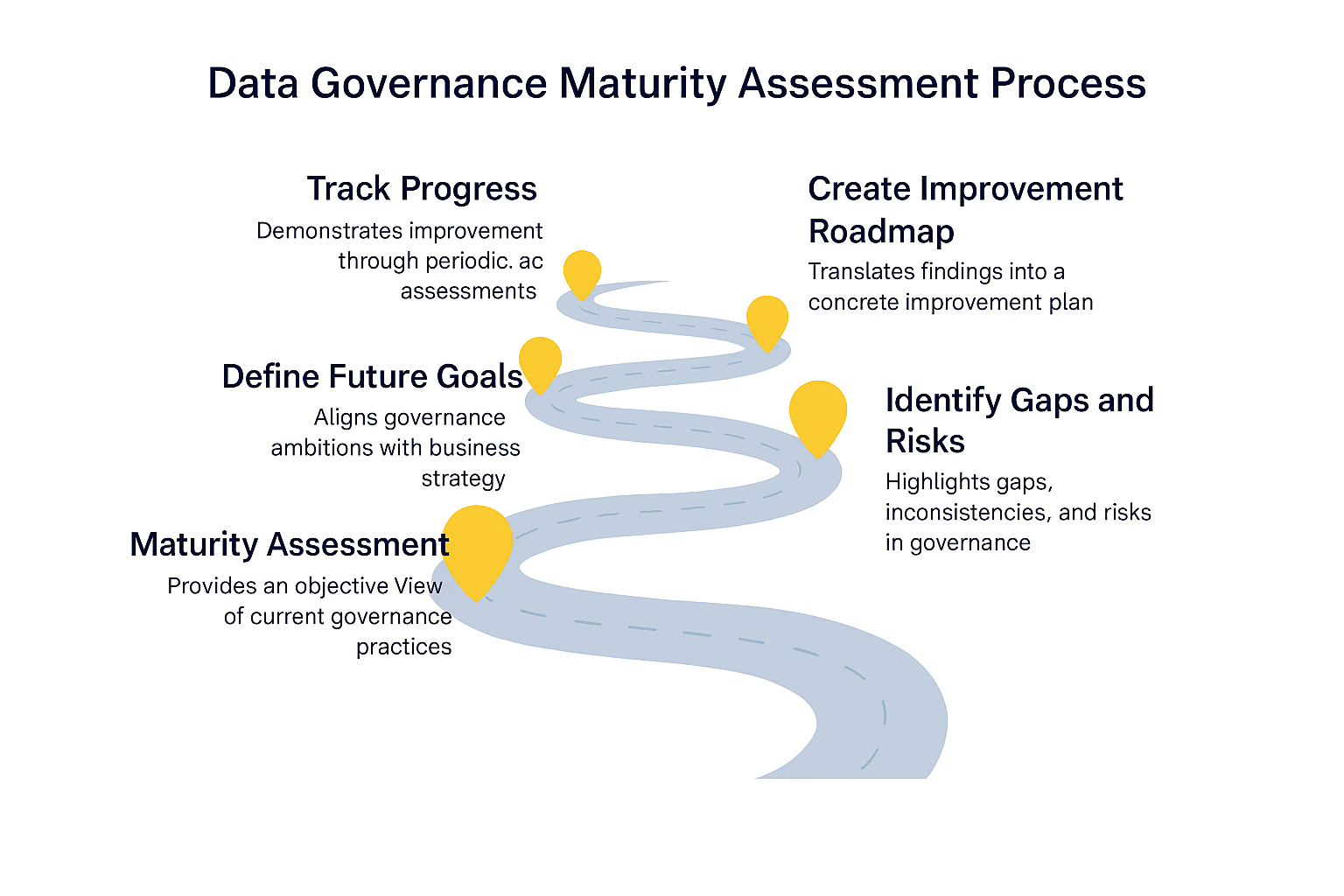
Why every governance journey begins with a maturity check ?
A maturity assessment provides a baseline and a roadmap:
- Where you are today.
- Where you want to be based on strategy, regulation, or business needs.
- How you’ll get there with concrete, prioritized actions.
- Evidence for auditors that you are on a continuous improvement journey.
- Proof of progress over time through repeated assessments.
In an environment shaped by GDPR, DORA, and the EU AI Act, having documented evidence of your governance maturity is no longer optional - it's a regulatory expectation.
Recognized Data Governance Frameworks
Using recognized models matters, because it enables benchmarking against other organizations - critical for audits, board reporting, and regulatory reviews.
There are many recognized frameworks that can serve as the assessment base - each with its own strengths and limitations. The most commonly used include:
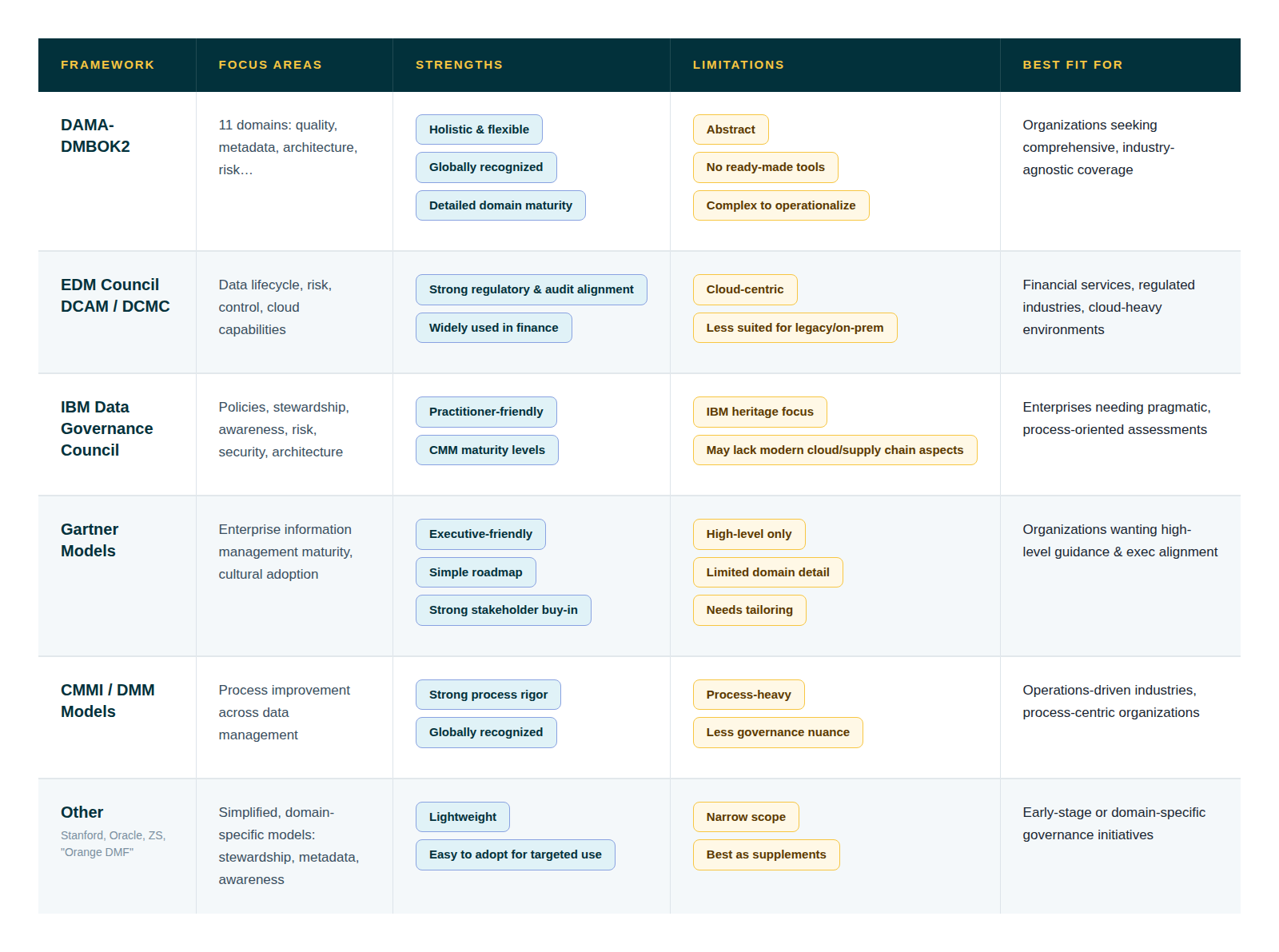
Framework vs Reality
In practice, even the best frameworks cannot be applied “as-is.” They must be tailored to the organization’s reality:
- Its structure (centralized, federated, hybrid, holding model, groups with semi-independent subsidiaries).
- Its lifecycle stage (startup, merger, transformation, or crisis).
- Its regulatory environment (privacy, financial, AI).
.png)
The most effective approach is often hybrid: combine one or two standard frameworks with organizational needs, simplify the criteria, and make it a repeatable tool that drives action rather than a one-off academic exercise.
How do you ensure a Maturity Assessment delivers real value?
A maturity assessment adds real value only when done properly.
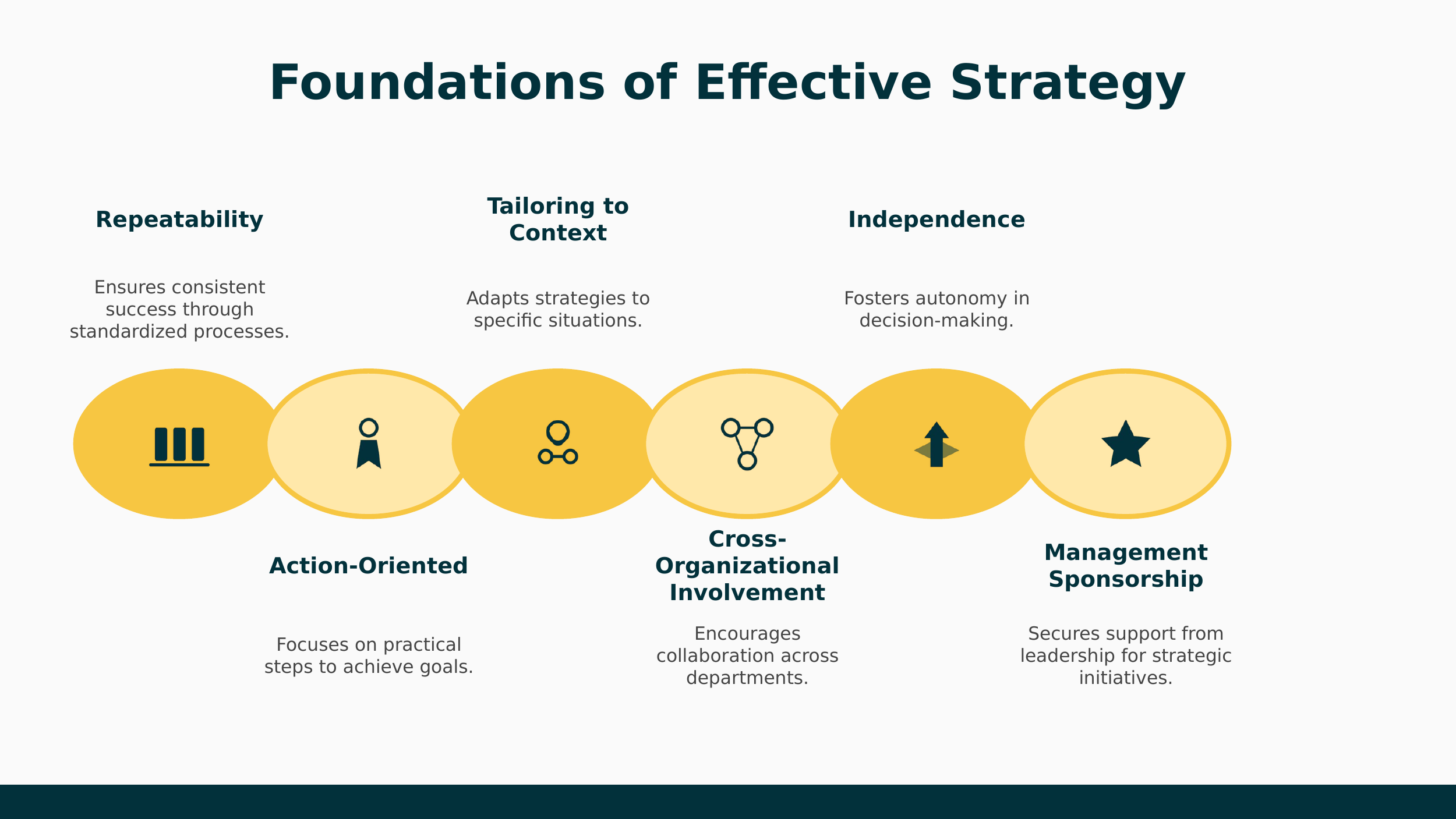
- Make it Repeatable
- A single assessment gives a snapshot. To prove progress and satisfy auditors, assessments should be repeated periodically (e.g., annually or bi-annually).
- Turn Findings into Actions
- The process must end with clear, addressed gaps and required actions, not just a report.
- Organizations should prioritize which areas to improve and align them with business priorities.
- Tailor it to Your Reality
Activities must reflect the organization’s characteristics and lifecycle stage:
- Is it a newly formed company?
- Is there a major organizational change, merger, or crisis?
- Are new regulations looming (e.g., AI Act, DORA, privacy laws)?
Governance maturity targets should adapt to these realities.
- Involve the Right People
Governance isn’t an IT-only matter. The assessment must gather input from:
- Technical teams (for systems, lineage, and controls).
- Business analysts and report creators (for practical usage).
- Data consumers (for accessibility and trust in data).
- Compliance, risk, and audit functions (for regulatory fit).
- Ensure Independent Review
- The first assessment (and periodic ones) are best done by an external partner or an internal compliance/audit team not involved in operations.
- This reduces bias and ensures results are credible to auditors and executives.
- Secure Executive Sponsorship
- Without a sponsor at the management level, recommendations risk staying on paper.
- Results often touch on operating models, roles, or technology stack decisions, which require leadership buy-in to act.
From Knowing to Doing
A maturity assessment is often the best starting point for any data governance journey. It helps you see where you are today, understand the gaps, and set realistic goals for where you want to be. Repeating the process over time provides evidence of progress and a clear story for both management and auditors.
If you're ready to understand where your organization stands on the data governance maturity scale, Elitmind can help. We've conducted numerous assessments across industries and regions using a proven, framework-based methodology - particularly in sectors such as energy, manufacturing, pharma, and healthcare, while our approach is applicable across all industries.
We deliver projects both across Europe with a strong focus on regulatory requirements and globally, supporting organizations in diverse markets worldwide.
Reach out to schedule a no-obligation conversation and come away with a clearer picture of where to start.
Meet the authors

.jpg)



.png)







.png)


.png)
.png)










.png)