What is a data catalog and why can't modern data governance work without one?
.jpg)
Audio Highlights
This component uses custom JavaScript to open and close. Custom attributes and additional custom JavaScript is added to this component to make it accessible.
Video Highlights
This component uses custom JavaScript to open and close. Custom attributes and additional custom JavaScript is added to this component to make it accessible.
At a board meeting, finance and sales presented different customer revenue numbers. Both teams were confident their figures were correct, yet the numbers did not match. Instead of discussing business performance, leaders spent the meeting debating whose data to trust.
This happens in many organizations. The issue is not a lack of data, but a lack of shared understanding of what the data means and where it comes from. A data catalog solves this problem.
What is a data catalog and how is it different from a data warehouse or a data lake?
A data catalog is a centralized inventory of an organization’s data assets enriched with metadata - information about the data itself. Think of it as a library card catalog for data: instead of books, it indexes datasets, tables, files, dashboards, APIs, and more.
In the context of data governance, the catalog becomes the control center:
- It enables users to find and understand data.
- It connects technical details with business meaning.
- It enforces governance policies such as access rights, classifications, and sensitivity labels.
- It creates transparency and accountability across the data landscape.

A data catalog is not just a tool for IT - it is a bridge between governance principles and everyday business use of data.
What features should a data catolog have? A practical breakdown.
Today, the market is full of tools that advertise data catalog capabilities; each has its strengths, integrations, and focus areas. But regardless of brand, a true data catalog should provide a set of core functionalities that make it valuable for both governance and business users alike.

How does a data catalog manage metadata across systems?
Collects metadata from multiple systems (databases, data lakes, reports, APIs) and organizes it in one place. It combines technical metadata (tables, fields, schema), business metadata (definitions, glossary, owner), and operational metadata (usage, frequency, lineage). Users can see not only what data exists but also how it is described, used, and governed.
- Governance value: Ensures consistency, stewardship, and transparency.
- Business value: Eliminates misunderstandings about definitions (“customer,” “order”), speeds reporting, and increases trust in data-driven decisions.
How do business users find the right data without asking IT?
Provides a Google-like search bar (increasingly with AI/NLP capabilities) that allows business users to type “sales by region” and instantly find certified datasets, dashboards, or reports. Discovery can be filtered by business domain, steward, sensitivity level, or quality rating.
- Governance value: Directs users to governed, approved assets instead of uncontrolled shadow data.
- Business value: Cuts hours or days spent asking IT “where do I find this data?”, enabling faster analysis and insights.
Central Inventory of Data Assets
Creates a structured, searchable index of all data assets across the organization: tables, files, dashboards, reports, pipelines, APIs. Provides visibility into the full data landscape, including duplicates, unused datasets, and critical assets.
- Governance value: Provides accountability and a “single source of truth” about what exists and who is responsible.
- Business value: Reduces wasted effort recreating data, helps reuse trusted assets, and avoids paying for redundant storage.
What is business glossary and why does it prevent reporting conflicts ?
Links a business glossary (definitions of terms like “Active Customer”) with the technical data dictionary (field names, types, tables). Creates a clear mapping between business language and technical implementation.
- Governance value: Guarantees consistent understanding across departments and regulatory alignment.
- Business value: Prevents reporting conflicts, ensures KPIs are comparable across functions, and improves communication between IT and business.
How does data lineage show where a KPI actually comes from?
Visualizes how data flows end-to-end: from source systems (CRM, ERP) through transformations and warehouses into dashboards and KPIs. Allows users to trace a metric like “Net Revenue” back to its raw source tables. Also shows downstream dependencies, so teams know what breaks if a source changes.
- Governance value: Provides audit trails and demonstrates regulatory control.
- Business value: Builds confidence in reports, helps assess risks of changes, and reduces errors in critical reporting.
Data Profiling & Quality Indicators
Scans datasets automatically to detect patterns, anomalies, missing values, duplicates, and validity against business rules. Presents users with a “data quality scorecard” before they start using the data.
- Governance value: Turns abstract data quality policies into measurable evidence.
- Business value: Prevents costly mistakes (e.g., marketing campaigns run on incomplete customer lists), improves efficiency, and ensures better customer experiences.
Collaboration & Knowledge Sharing
Provides collaboration features such as comments, annotations, endorsements, FAQs, usage tips, and dataset ratings. Allows analysts and stewards to share knowledge directly in the catalog instead of in isolated files or emails.
- Governance value: Extends stewardship into daily workflows and captures institutional knowledge.
- Business value: Reduces rework, spreads best practices, and shortens onboarding for new employees.
Governance & Policy Enforcement
Embeds governance rules directly into data usage: assigning owners and stewards, labeling datasets as confidential/public, enforcing access restrictions, applying retention schedules, and flagging sensitive data (PII, PHI). Often integrates with IAM/security tools to automate enforcement.
- Governance value: Operationalizes governance policies, ensuring compliance is not just documented but applied.
- Business value: Reduces regulatory fines, avoids reputational risk, and ensures sensitive data is protected by design.
Automation with AI/ML
Uses machine learning to auto-classify datasets (e.g., recognizing emails, phone numbers, credit card numbers), detect sensitive fields, recommend lineage relationships, and even suggest potential data owners. Helps maintain the catalog with minimal manual work.
- Governance value: Makes governance scalable, accurate, and sustainable as data grows.
- Business value: Reduces manual effort by data teams, speeds up catalog adoption, and ensures hidden risks (like untagged PII) are surfaced quickly.
The Big Picture
A data catalog is more than an index of datasets. It is the operating system for data governance. By combining metadata, search, lineage, quality checks, collaboration, and policy enforcement, it translates governance principles into everyday practice.
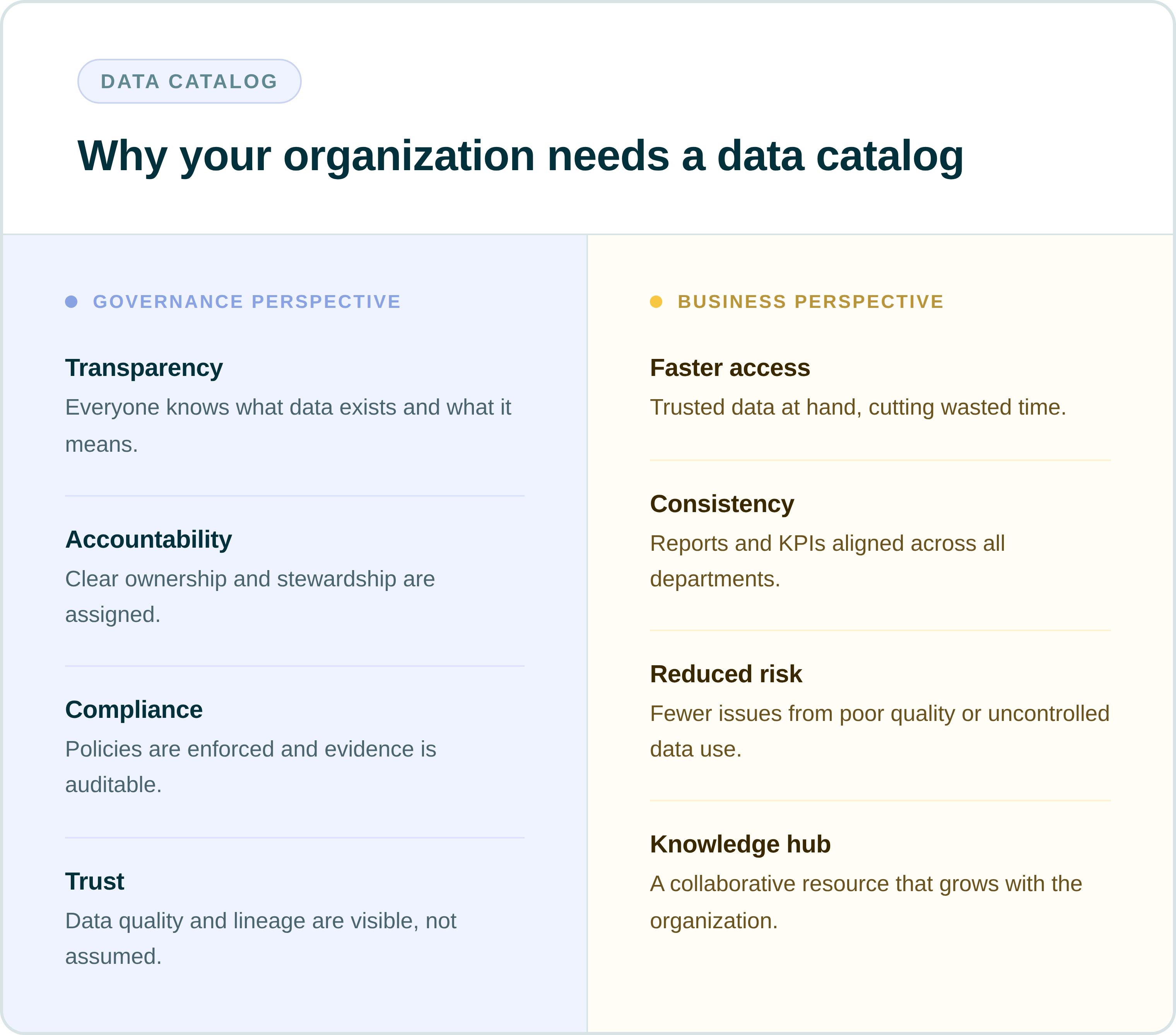
In short, a data catalog connects the governance framework with the business need for reliable insights. It makes data not just available, but also usable, trusted, and compliant - turning governance principles into practice.
Not sure where to start with a data catalog in your organization?
In a 30-minute call we will walk you trough how companies in your industry have tackled this and what a realistic first step looks like for you. Book a call.
FAQ SECTION
Is a data catalog the same as a data dictionary?
No. A data dictionary documents technical field names and types. A data catalog connects those fields to business definitions, ownership, lineage, and quality scores.
Do I need a data catalog if we are a small company?
If more than one team shares data or builds reports, you benefit from a catalog, even a lightweight one. The complexity threshold is lower than most people expect.
Meet the authors

.jpg)



.png)






.png)


.png)
.png)











.png)