Why Do So Many Data Governance Initiatives Fail – and How to Get Them Right
.jpg)
Audio Highlights
This component uses custom JavaScript to open and close. Custom attributes and additional custom JavaScript is added to this component to make it accessible.
Video Highlights
This component uses custom JavaScript to open and close. Custom attributes and additional custom JavaScript is added to this component to make it accessible.
Imagine your company runs a fleet of vehicles.
You would never accept not knowing where they are, who is responsible for them or whether they are safe to drive. Yet many organizations treat their data, an asset used every day in nearly every decision, with far less care. Datasets live in scattered systems, nobody is sure who owns them, and their quality is discovered only when a report turns out to be wrong.
Data governance exists to close that gap. And yet, despite its importance, many governance initiatives never deliver the results they promised.
What data governance really is
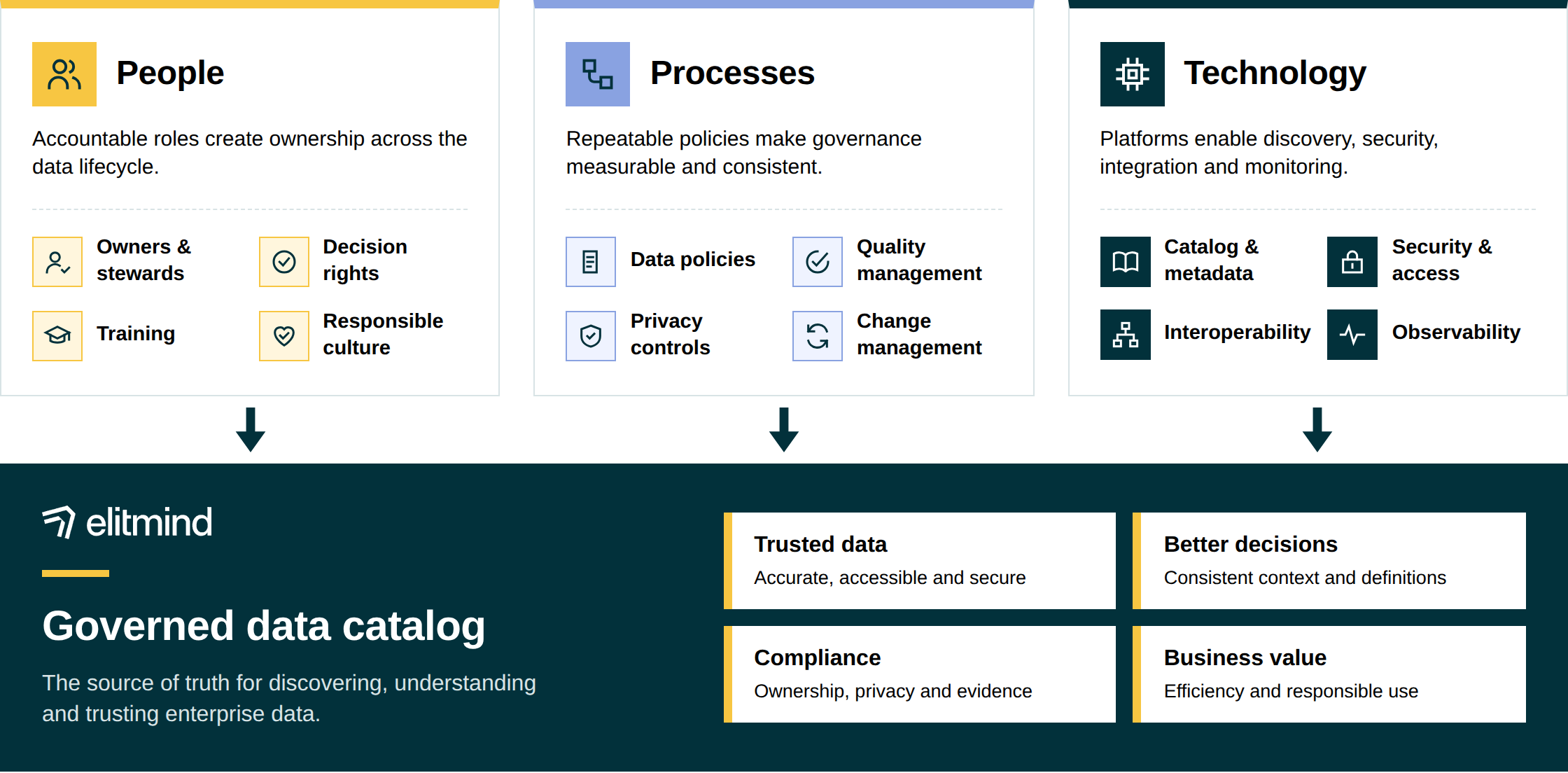
Data governance is often described as a combination of people, processes and technology. It is a useful starting point, but it hides the most important part: governance is about decisions and accountability. It defines who owns which data, what “good” data means, which rules apply to it and how those rules are enforced in daily work.
Technology supports this, but it cannot replace it. That is exactly why governance is so hard: it changes how people work, not just which tools they use.
The business side: why initiatives stall
No real executive sponsorship
Without visible support from top management, governance is quickly seen as “extra work” rather than a business priority. Teams do not get the people they need, and key stakeholders have no reason to commit.
What helps: a named executive sponsor who ties governance to business outcomes such as regulatory compliance, faster reporting or readiness for AI, and who reviews progress regularly.
Unclear goals and underestimated scope
Many initiatives start with a vague ambition to “govern our data”. Without a clear vision of what should change, it is hard to align people, estimate effort or secure adequate funding. As a result, governance is often underfunded from the start, because nobody can articulate what the investment will deliver.
What helps: a realistic roadmap that starts with a small number of high-value use cases, with measurable goals for each stage.
Resistance to change
Governance introduces new responsibilities, new rules and sometimes new tools. Resistance can come from every level of the organization: from business users who see it as bureaucracy, to IT teams who fear losing control. It can be a significant obstacle to the successful implementation of governance.
What helps: showing people what they gain, for example less time spent reconciling numbers or searching for the right dataset, rather than only what they must now do.
Poor communication and training
Data governance is a cross-functional initiative that requires a common understanding of roles, responsibilities and processes. When communication is inconsistent and training is missing, the result is confusion, uncertainty and very slow adoption.
What helps: clearly defined roles (such as data owners and data stewards), simple guidelines and ongoing training rather than a one-time kickoff.
No domain perspective
When an organization is not yet mature enough to define its data domains, such as finance, sales or supply chain, it is difficult to assign ownership or manage data products. As a result, maintaining data products, managing their lifecycle and enforcing governance standards become inefficient and fragmented.
What helps: mapping key data domains early and assigning ownership within the business, not only within IT.
The technical side: why initiatives fail to scale
Not knowing what data you have
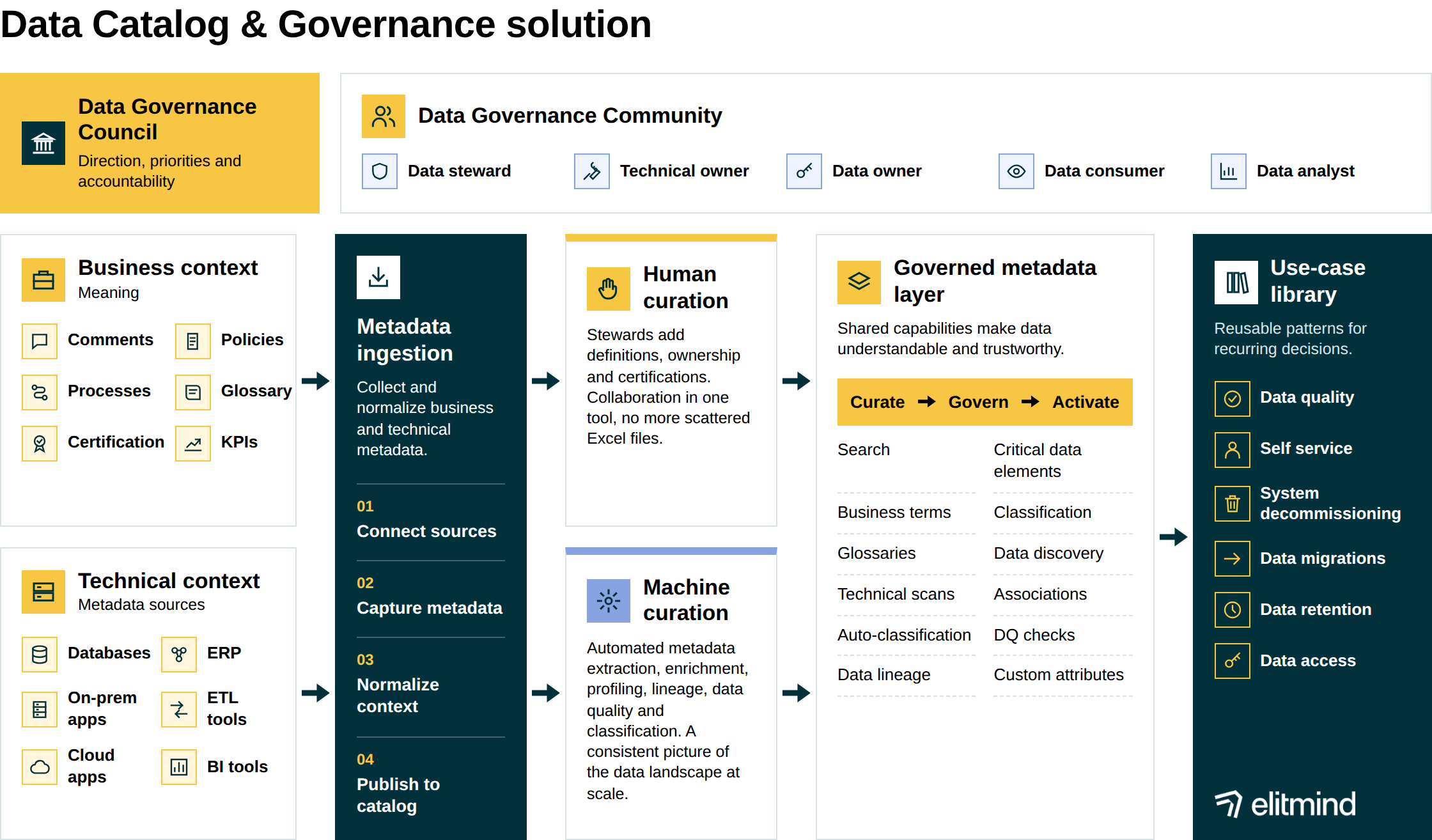
You cannot govern what you cannot see. Companies without a metadata-driven data catalog lack a systematic view of their data landscape: what exists, where it lives, who uses it and how it flows between systems. To return to the fleet analogy, this is like managing vehicles without a registry.
Treating data quality as a separate topic
Data quality is one of the most visible outcomes of good governance, yet it is often left out of governance initiatives. Without quality rules, monitoring and clear responsibility for fixing issues, poor data keeps leading to incorrect insights and wrong decisions, and trust in data erodes.
Data silos
When data is scattered across multiple systems and departments, it is challenging to get a complete and accurate view of ourthe company’s data asset landscape. The same business concept can be defined differently in different places. This can result in inconsistencies and gaps in governance policies and good practices.
Solutions that do not scale
Data governance programs need to be able to grow and adapt to the company scale’s growth: more data sources, more users, more regulations. Without processes and technology that can scale, the data governance program can quickly become outdated.
No tool to run the governance cycle
Governance is a continuous process, not a one-time project. Without a data governance tool (usually part of a data catalog platform), nobody can track what is already resolved, what is still open and who is responsible for the next step. And no, an ordinary Excel file will not work here.
Governance in the age of AI: the missing semantic layer
AI agents and generative AI tools are only as reliable as the context they receive. If “customer”, “active contract” or “revenue” mean different things in different systems, an AI agent will not resolve that ambiguity. It will simply produce confident, inconsistent answers.
Ontologies and semantic models provide that missing context. They describe business concepts, how they relate to each other and how they map onto physical data. Combined with a business glossary and a data catalog, they turn governed data into something AI can actually understand and use.
In other words, governance is no longer only about compliance and reporting. It is becoming a prerequisite for using AI safely and effectively.
What helps: building a shared business glossary early and connecting it to the catalog, so that the semantic layer grows alongside governance rather than as a separate project later.
How to get it right
Successful data governance initiatives tend to share a few characteristics:
- they have an engaged executive sponsor and goals linked to business value;
- they start small, with a clear roadmap, and scale step by step;
- they define ownership through data domains and clear roles;
- they treat data quality as a core part of governance;
- they rely on a data catalog and a governance tool rather than spreadsheets;
- they build a semantic layer that prepares data for AI.
Data governance is difficult because it touches people, processes and technology at the same time. But organizations that approach it as a continuous business capability, not a one-off IT project, gain something increasingly valuable: data they can trust, and data their AI can understand.
Planning a data governance initiative or preparing your data for AI? Talk to our experts at Elitmind.
Meet the authors






.png)







.png)


.png)
.png)










.png)