Data Governance Roadmap: 6 Steps to Stay Compliant With EU Data Act, AI Act & ESG
.jpg)
Audio Highlights
This component uses custom JavaScript to open and close. Custom attributes and additional custom JavaScript is added to this component to make it accessible.
Video Highlights
This component uses custom JavaScript to open and close. Custom attributes and additional custom JavaScript is added to this component to make it accessible.
Regulations are changing fast - and the EU Data Act, AI Act, and ESG disclosures are just the beginning. As new demands keep emerging, organizations need to stop treating data governance as a one-time compliance task.
What's needed is a strategic, scalable approach - flexible enough to handle future laws without rebuilding everything from scratch. The key is a solid, principles-based roadmap rooted in global standards. It's not just about staying compliant today: it's about being ready for what's next.
.png)
6 Steps to Data Governance Roadmap
This 6-step guide comes from real experience helping teams navigate shifting regulations and the growing pressure to use data more effectively. It's a practical way to build a governance roadmap that works now and can be iterated as your organization evolves.
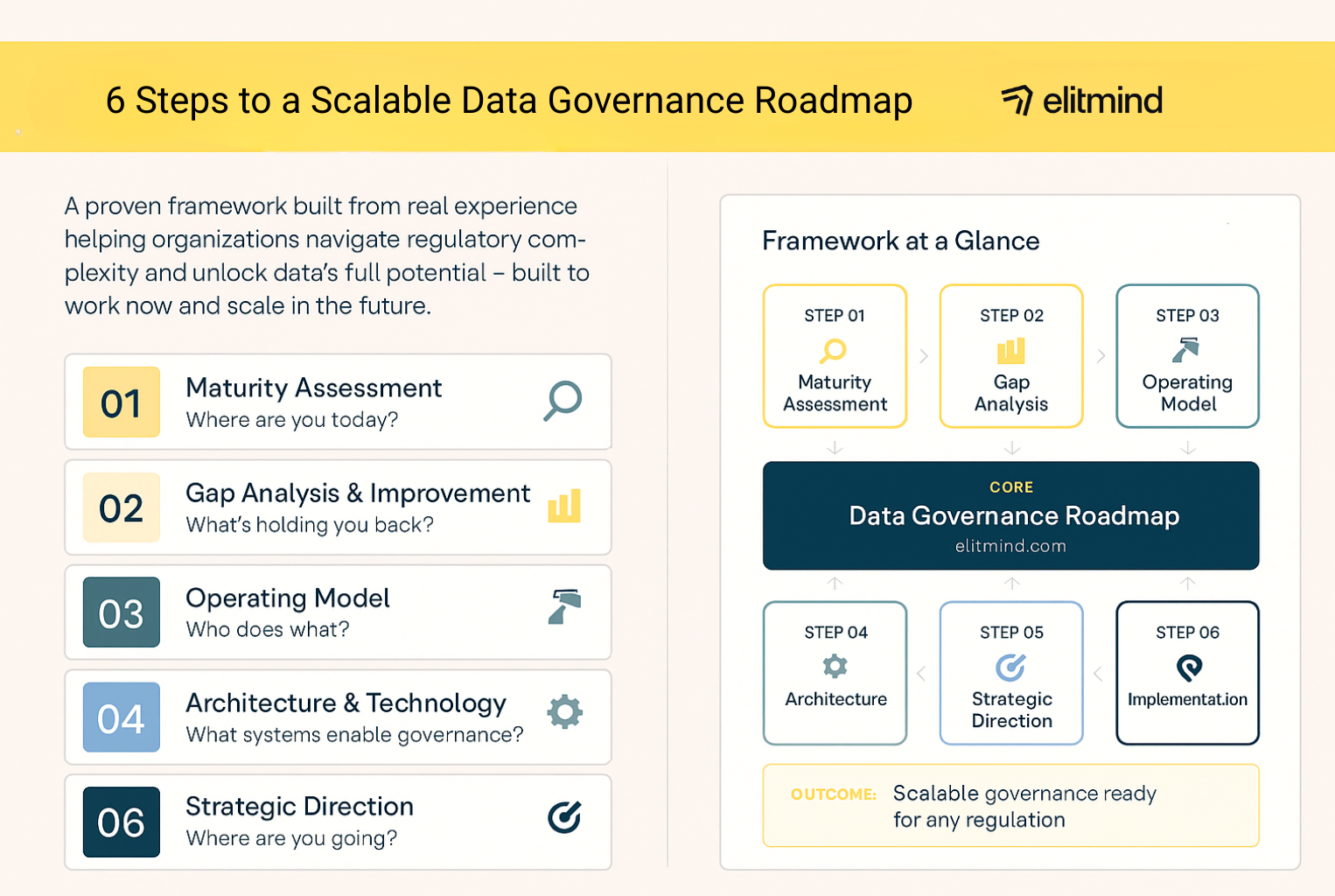
Step 1 : Conduct a Data Governance Maturity Assessment
Before building any data governance roadmap, you must answer one fundamental question: Where are we today - and how do we measure progress?
A maturity assessment provides the foundation to:
- Identify capability gaps
- Benchmark against global standards
- Set realistic goals
- Track progress over time
Use globally recognized frameworks such as:
- DAMA-DMBOK – Data management best practices
- DCAM (EDM Council) – Enterprise data management
- CDMC – Cloud/hybrid governance
- IBM and Gartner models – Strategy and enterprise alignment
Adapt a framework to fit your organization. The best tools are reusable - for both initial audits and ongoing governance tracking.
Step 2 : Identyfity Gaps and Define Targeted Improvements
With your current maturity mapped, the next step is to pinpoint key capability gaps and translate them into focused improvement actions.
Assess where your current approach limits:
- Business agility and innovation
- Data usability for analytics, AI, and decision-making
- Operational efficiency and scalability
- Cross-functional collaboration and trust in data
You're not only looking for compliance risks - you're identifying what’s preventing data from delivering value.
From Gap to Action:
For each issue identified, define:
- What’s missing (e.g., unclear ownership, siloed quality processes, fragmented tools)
- Why it matters (impact on speed, insight quality, decision-making, or cost)
- What to do (short-term fixes, capability builds, long-term investments)
Example: No enterprise metadata strategy → slows onboarding of new analytics projects → recommend implementing a unified metadata and cataloging platform.
Prepare a structured, prioritized improvement plan that balances:
- Quick wins for momentum
- Foundational enablers for scalability
- Strategic shifts for long-term transformation
This step ensures your roadmap is built on real business needs, not just regulatory checklists - and that every initiative has a clear purpose and outcome.
Step 3 : Define the Operating Model for Data & Analytics
Now that you know where the gaps are, it’s time to design a target operating model that makes data governance and analytics work in practice.
This is about putting the right people, roles, and processes in place to manage and use data effectively across the organization.
What the Operating Model Should Define:
- Organizational structure – Where does data governance live? What’s the role of the CDO, data owners, data stewards, and analytics leads?
- Roles & responsibilities – Who makes decisions, who enforces policies, who ensures data quality, and who drives data value?
- Core governance processes – Data onboarding, quality assurance, access control, issue resolution, and lifecycle management.
- Decision-making forums – Data councils or steering groups that align business, IT, compliance, and analytics.
With a well-defined model, governance becomes a part of how your organization works.
Step 4 : Define Data Architecture and Technology Requirements
To enable effective data governance and analytics, you need more than policies and roles - you need a data and systems architecture that supports your vision.
This step focuses on designing a target architecture that enables secure, scalable, and business-aligned data management across the organization.
What to define:
- Data architecture principles – How will data be stored, integrated, and accessed?
- System integration – How do core systems (ERP, CRM, ESG, AI/ML platforms) interact and share data?
- Metadata and lineage tools – How will data be discovered, classified, and tracked across its lifecycle?
- Analytics platforms – Are your tools fit for purpose? Do they support self-service, scalability, and governance?
- Security and access management – How do you enforce roles, rules, and data protection at scale?
With the right architecture in place, your governance roadmap becomes executable, your data becomes accessible and trusted, and your strategy becomes scalable by design.
Step 5 : Define Strategic Directions and Governance Initiatives
With the operating model and architecture defined, the next step is to turn your insights into a clear strategic direction.
What to define:
- Strategic focus areas – What are the top governance priorities over the next 1–3 years? (e.g., trusted data for AI, ESG reporting integrity, data monetization readiness)
- Guiding principles – How will your organization approach governance going forward? (e.g., federated model, “data as a product”, self-service with control)
- Initiatives and programs – Concrete actions that bring the strategy to life:
- Enterprise data catalog rollout
- Data literacy and enablement program
- Metadata automation and lineage tracking
- Implementation of data product ownership model
- Integration of data governance with ESG and AI workflows
Not every initiative is technical - many are about process, culture, and capability building. With strategic direction in place, the roadmap becomes more than a project plan - it becomes a governance strategy that grows with the business.
Step 6: Develop the Data & Analytics Strategy Implementation Roadmap
With your strategic direction and initiatives defined, the final step is to build a clear, actionable implementation roadmap - outlining what happens, when, and by whom.
This is where planning becomes execution.
What the Roadmap Should Include:
- Phases and timeline – Break down the strategy into achievable time intervals
- Key initiatives and milestones – Align each initiative with specific goals, dependencies, and success metrics
- Ownership and responsibilities – Assign business and technical leads for each stream
- Quick wins vs. long-term enablers – Balance early momentum with strategic foundation-building
- KPIs and monitoring – Define how progress and impact will be measured and reported
Ready to build a governance roadmap that lasts?
If you want data governance that actually works, start with the facts - where you are now, what's broken, and what's missing. From there, define the roles, processes, and systems that make data usable, trusted, and secure across the business.
Do it right the first time, and you won't have to rebuild every time a new regulation or business demand appears.
At Elitmind, we help organizations design and implement data governance strategies that are practical, scalable, and built for the long term - not just the next audit.
Let's talk. Reach out to us to schedule a free consultation with our data strategy team.
Meet the authors

.jpg)





.png)






.png)

.png)
.png)











.png)