Azure Local: Data Sovereignty and Hybrid AI for Enterprise
Audio Highlights
This component uses custom JavaScript to open and close. Custom attributes and additional custom JavaScript is added to this component to make it accessible.
Video Highlights
This component uses custom JavaScript to open and close. Custom attributes and additional custom JavaScript is added to this component to make it accessible.
The cloud narrative promised simplicity: everything moves to the public cloud, and infrastructure complexity goes away. But that narrative is colliding with reality. Data that cannot cross borders. regulators asking harder questions. AI workloads that cannot send sensitive data to external APIs. Boards that want operational resilience, not vendor lock-in.
Microsoft just gave us the tools to build an architecture that addresses those realities. And I want to tell you plainly what that means - not from a marketing slide deck, but from an engineering perspective.
Stop pretending everything has to go to the cloud
For years, the dominant narrative went like this: if you are not moving to the public cloud, you are doing something wrong. And yet, in conversations with customers across Europe, I keep hearing different questions - asked more directly every year:
"What if the geopolitical climate shifts and someone turns off the tap?"
"What if the regulatory environment in five years is even stricter than it is today?"
"How do we operate if the cloud stops being the obvious answer - not technically, but politically, legally, from a cost perspective?"
Microsoft is not retreating from the cloud. It is doing something more interesting: closing the loop on the hybrid model. The message to customers is clear - you have every right to want local control, data sovereignty, and a credible Plan B. And now you have the building blocks to make it real.
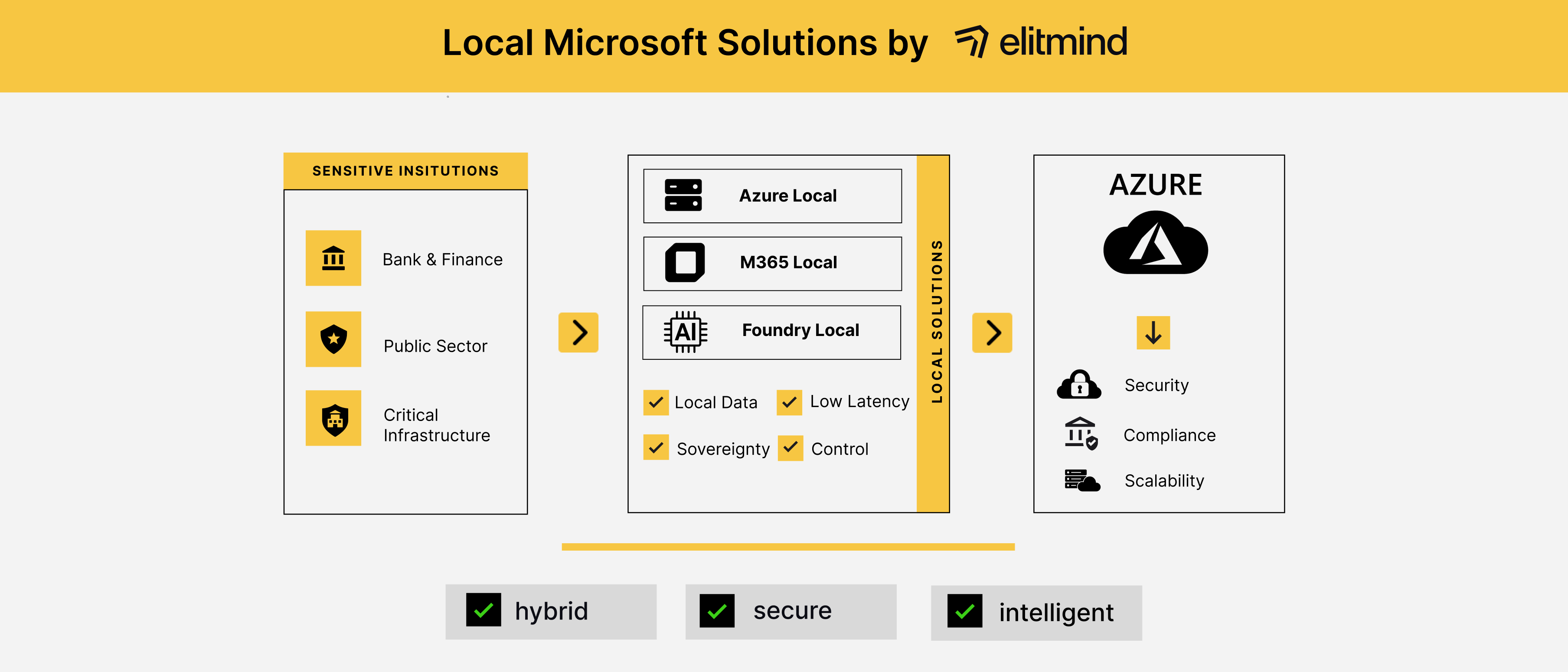
Those building blocks are: Azure Local, Microsoft 365 Local, and Foundry Local.
Azure Local - Azure, running from your own data center
Let’s start with the simplest truth: Azure Local is not an entirely new product. It is Azure Stack HCI rebranded and meaningfully expanded. Microsoft stopped selling a technology stack and started selling an operational model: Azure, but running locally.
What that means in practice
- Your HCI infrastructure: compute, storage, networking - runs in your own data center or at the edge.
- Instead of classic on-premises management, you operate it like Azure: through policies, Azure Arc, centralized monitoring, role-based access control, and compliance tooling.
- You run the same workloads you would expect from Azure: virtual machines, containers, managed services - except the hardware is physically yours.
What's new
Microsoft has significantly expanded Azure Local’s capabilities over the past several months. A few things are worth calling out specifically:
- Multi-rack deployments at scale - Azure Local now supports hundreds of servers across multiple racks, addressing large private cloud environments and eliminating cluster fragmentation.
- External SAN storage support - organizations can connect their existing on-premises storage to Azure Local, preserving prior investments while gaining cloud-native governance.
- NVIDIA RTX Pro 6000 Blackwell Server Edition GPU support (GA) - enabling high-performance, sovereign AI inferencing on-premises, with support for over 1,000 models including GPT OSS, DeepSeek-V3, Mistral NeMo, and Llama 4 Maverick.
Why it matters
The world is not black and white. There are organizations where data simply cannot leave their environment - because of regulation, contracts, or classification requirements. There are environments where latency is critical: manufacturing, OT systems, defense, telco. There are CISOs who will tell you that physical control over infrastructure is not a preference, it is a compliance condition. And there are boards that want a credible operational resilience plan.
Azure Local is Microsoft’s answer to those organizations: you want the Azure operational model, but you need the iron to stay on your premises. That is now a fully supported, enterprise-grade option.
Microsoft 365 Local - when sovereignty is more than a slide deck
Microsoft 365 Local reached general availability and is a direct signal to regulated sectors: public sector, defense, financial services, healthcare, and critical national infrastructure. To organizations that have been saying for years: the cloud sounds great, but show me how I pass a data sovereignty audit.
Microsoft 365 Local delivers the full M365 productivity stack: Exchange Server, SharePoint Server, and Skype for Business Server - running entirely within your sovereign operational boundary on Azure Local. Workloads stay inside your environment, with no dependency on Microsoft-operated cloud infrastructure.
Why this is a language change, not just a feature update
- Europe is no longer a special case: it is becoming one of the primary drivers of Microsoft’s global product strategy.
- Regulators are no longer asking whether cloud is acceptable. They are asking whether you can demonstrate control over data flows, processing locations, and access governance.
- For the first time, Microsoft is explicitly communicating: we understand that not every organization can operate in a full SaaS model in the public cloud.
If you are a CIO in a European regulated institution, this is not a minor feature addition. It is a shift in what you can say to your regulator, your board, and your auditor.
Foundry Local - AI local-first, driven by physics, not ideology
Foundry Local is part of Microsoft Foundry. The platform is a cloud-native environment for building and operating AI applications. Foundry Local addresses a specific problem within that ecosystem: how to run AI inference on your own hardware, without sending data to an external API endpoint.
How the three components fit together
- Azure Local = local Azure-consistent infrastructure.
- Microsoft 365 Local = productivity and collaboration within a sovereign operational boundary.
- Foundry Local = local AI inference, exposed through an OpenAI-compatible API endpoint - except inference runs on your hardware, not in the cloud.
In AI, local-first very often has nothing to do with ideology. It comes from physics, risk, and unit economics:
- You do not want to send document content and PII to an external API.
- You need to operate offline or in a low-connectivity environment.
- You need extremely low latency for real-time operational systems.
- You have run the math on token costs and found that AI-as-a-service does not work at your volumes.
What does this look like in a real organization?
Consider an organization in financial services, insurance, or healthcare. Significant volumes of sensitive data: client documents, policy applications, case correspondence, transaction records. The leadership position is clear: we want AI, we want Copilot-style automation — but our most sensitive data is not going into the public cloud.
A practical local-first architecture
- Azure Local in the primary data center - a unified operational model for infrastructure, policy enforcement, security monitoring, and compliance. One governance layer, not a patchwork of separate on-premises tools.
- Microsoft 365 Local for productivity and collaboration that touches regulated data - documents, communications, case management - where the data residency requirement is non-negotiable.
- Foundry Local as the on-premises AI inference endpoint: summarizing documents, classifying cases, extracting structured fields from applications, suggesting responses for agents - without any document content leaving the organization’s sovereign boundary.
For cases where a larger or more specialized cloud model genuinely adds value, you build the following:
Local-first, cloud-when-needed. By default, everything runs locally. You go to the cloud only when there is a clear business, quality, or economic reason to do so — with a clean audit trail and an explicit governance decision.
This is not a retreat from the cloud. This is engineering.
The worst possible reading of Microsoft’s move here is that it represents an admission that cloud failed. That interpretation is wrong.
What it actually represents is an acknowledgment that:
- the world has become too complex to push every organization into a single deployment model,
- geopolitics and regulation have become too material to ignore in product strategy,
- a mature hybrid architecture is not a bit of on-premises and a bit of cloud - it is deliberate design: knowing what runs locally, what runs in the public cloud, why, and how you govern it as a coherent whole.
"Local" in Microsoft’s current framing is not nostalgia for the server room. It is the ability to say: we know what we keep in the public cloud, what we keep on-premises, and why - and we manage it all through a single operational model.
To put it plainly - over the past several months I have had many conversations where the answer to a sovereignty question was: technically possible, but operationally complex. Today that answer is different.
What does this mean for you?
If you are:
- a CIO or CISO in a regulated organization,
- an IT director responsible for modernizing legacy infrastructure,
- a business that wants to move into AI but is concerned about data leakage, cost, or audit exposure,
then the question is no longer "should we go to the cloud?" That question is behind you.
The right question today is:
What should we run local-first, what should we run cloud-first - and how do we connect them into a coherent architecture?
Not sure where Local fits? Let’s find out together.
If you are evaluating whether Local makes sense in your organization - whether that means:
- Azure Local (infrastructure, edge, hybrid),
- Microsoft 365 Local (productivity in a sovereign operational model),
- Foundry Local and AI local-first (where the cloud is the problem or the cost),
...reach out to us at Elitmind.
We will run a short Discovery engagement in which we:
- review your regulatory requirements,
- map out your data residency and sovereignty risk,
- model where Local is the right economic and operational decision versus where the public cloud wins,
- design a concrete local/hybrid architecture - not another presentation about digital transformation.
AI and cloud are not a matter of faith.
They are an engineering trade-off. And Microsoft just gave us some very interesting new piece.
Meet the authors





.png)







.png)

.png)
.png)










.png)